By Sergey Tselovalnikov on 19 November 2026
How to Be a 10x Engineer in 2027 and Beyond
You’ve probably heard of 10x engineers – legendary (or possibly rather mythical) software engineers who somehow achieve ten times what's expected of them. Every tech company wants to hire as many of those engineers as it can, and is often more than happy to reward them accordingly. And so it’s natural to ask a question – how do I become one?
In the era of AI agents, the answer might seem obvious – spin up an agent orchestrating other agents and get ten times more work done. This approach, while it might seem appealing at first, will likely only bring 10x the burnout and not much else.
In this article, I'll present an alternative path, so let's approach this step by step – as engineers do.
Who are they?
First, let's define what I mean by a 10x engineer for the rest of the article, as it's an incredibly overused and vague term. Taken literally, it means an engineer whose impact on the company is ten times that of someone the company would be perfectly satisfied with. But impact is just as vague, so for the sake of precision, let's define it as follows – if an engineer increases the company's share price by x%, a 10x engineer should increase it by ten times as much.
While the above definition might seem somewhat pointless, its main role is to highlight that producing 10x the code won't necessarily make you a 10x engineer unless that code has 10x the impact (hopefully positive) on the company.
What do they do?
The most naive approach to increasing your impact by 10x is to get ten times as much useful work done. Luckily, that's what AI has been promising us, right? One could try spending long hours orchestrating agents working on multiple tasks simultaneously. Unfortunately, following this approach would likely result in maybe 2–3x your normal throughput with a high risk of burnout in the best case. And in the worst, it will produce an imitation of productivity – multiple slop grenades that can, in fact, decrease the company's value. On top of this, you probably won't be the only engineer using AI at the company, and the expectations in the industry are shifting rapidly. So achieving 10x the impact relative to your colleagues might require 10x the hours in a day.
Rather than trying to get ten times more work done, a more promising path is to change what work the company does in the first place. In the AI era, this will likely mean identifying opportunities that were previously too expensive, too difficult, or simply impossible to pursue, and making them happen.
A good example of this came up in a recent Pragmatic Engineer podcast episode, where Gergely Orosz described an engineer whose company was paying a substantial share of its revenue to license a critical software component. Rebuilding it would've taken them years, making the investment hard to justify. But with AI agents, the engineer managed to build a faster replacement using the existing specifications and test suite. The original vendor ended up paying the company for the new implementation and for keeping it closed-source, so the vendor could license it to others, which drastically changed the economics of the business.
What happened is that the engineer identified and pursued a project that wouldn't have been economically viable in the pre-AI era. While this story might sound like another AI hype piece by itself, there were plenty of examples of such projects in the industry before AI.
- In the early 2000s, Paul Buchheit was working on Gmail and decided to build the interface in JavaScript, despite warnings from experienced engineers that it wouldn't work.
When I decided to write the Gmail interface in Javascript, pretty much everyone who knew anything about Javascript or web browsers told me that it was a bad idea. It had been tried in the past, and always ended in disaster. But times change fast, and fortunately I was in an environment where doing impossible things was not just permitted, but encouraged. After we launched, the impossible quickly became the new normal, completely changing how we think about web apps.
- In 2008, engineers at Philips were designing physical remote controls for their new colour-changing lamps. Once the iPhone opened up to third parties, they built an app as a mock-up of the physical controls, and soon realised that the smartphone could replace the remote entirely.
I was working in the pre-development department, designing remote controls for Philips LivingColors lamps. The iPhone had just come out, and I decided that, rather than building physical prototypes of the new remote control concepts, we would mock them up on an iPhone so that we could do user testing, try them out, and make small tweaks, without having to go through a hardware cycle. And that was actually the trigger. We found we had created a better way to control lights.
In all the above examples, we can observe a broader pattern – an engineer who’s deeply familiar with the company’s technology stack as well as the business side recognises a fundamental shift in the industry, pursues an opportunity newly enabled by that shift, and achieves outsized returns.
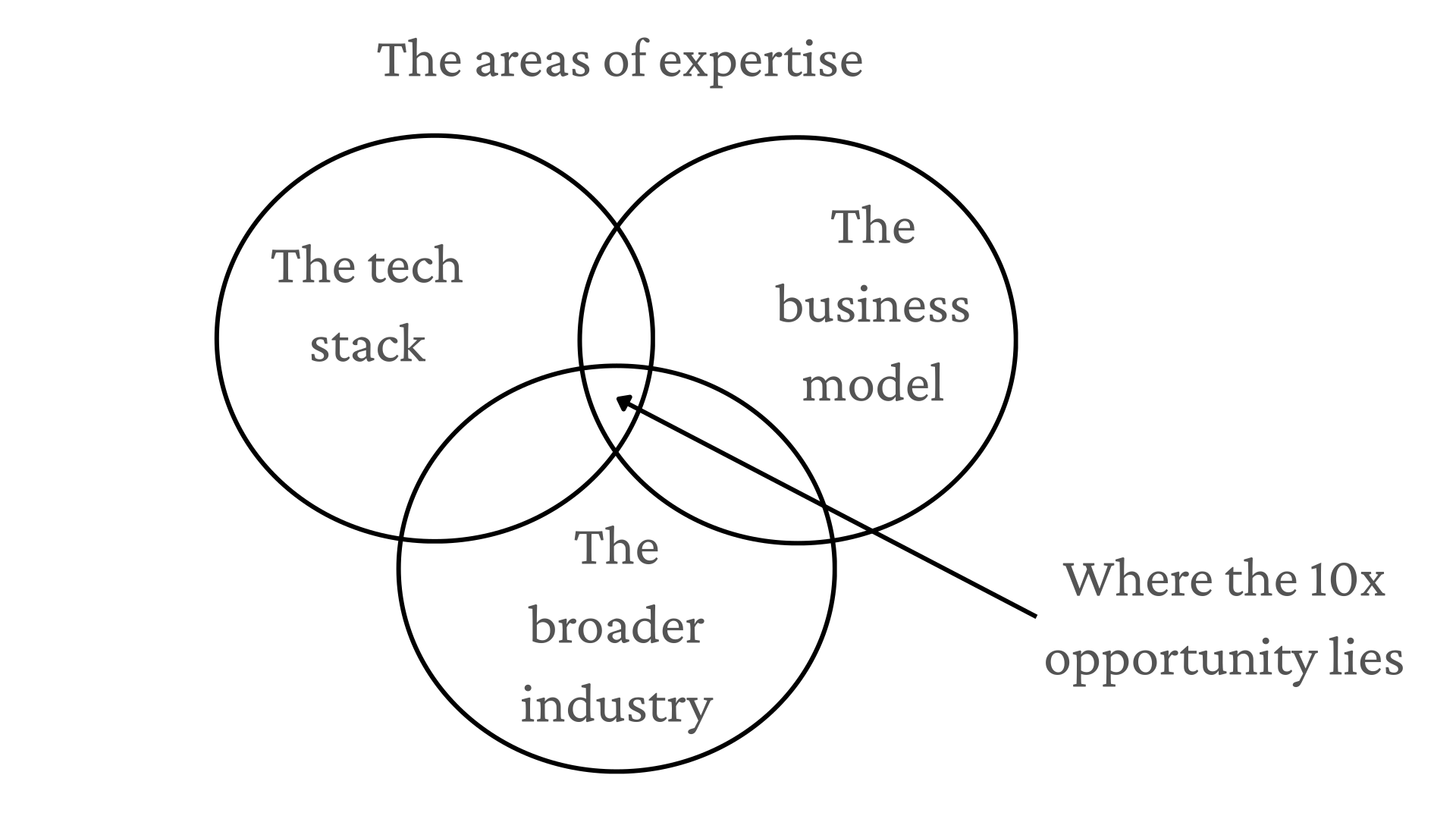
What makes the current situation unique is that you'd be hard-pressed to find an industry that hasn't been affected by AI in some way. Unlike many of the technological shifts in the past, often somewhat niche ones, AI has changed how software can be built, which has an effect on pretty much every company that uses or builds software. This means that, at least for some time, there might be plenty of opportunities for 10x impact for those who can successfully spot them and are able to make a bet.
Conclusion
(Un)surprisingly, what it takes to become a 10x engineer hasn't fundamentally changed with AI. It still requires a deep understanding of the business, the technology that powers it, and the broader industry where fundamental shifts happen.
The opportunities presented by the AI wave are similar to those presented by the previous technological shifts. Simply tokenmaxxing and churning out 10x more code is not necessarily going to produce outsized returns, despite what the vendors would like you to believe. The much greater opportunity is in looking for those ideas and projects that could previously have been thought of as too crazy to even attempt. It’s pursuing and successfully delivering those that can make a 10x impact on your company, and make you a 10x engineer.
Subscribe
If you liked this post, consider subscribing – I'll be sending an email every time I publish a new post, or sharing it on Hacker News to help spread the word.
Or, subscribe with RSS.